This article is for educational and informational purposes only. It reflects personal experience and publicly available clinical trial data. Nothing in this post constitutes medical advice. Retatrutide is not FDA-approved for human use. Do not use any compound discussed here without the supervision of a licensed medical professional.
Total Testosterone Over 900 and Still Feel Like Garbage?
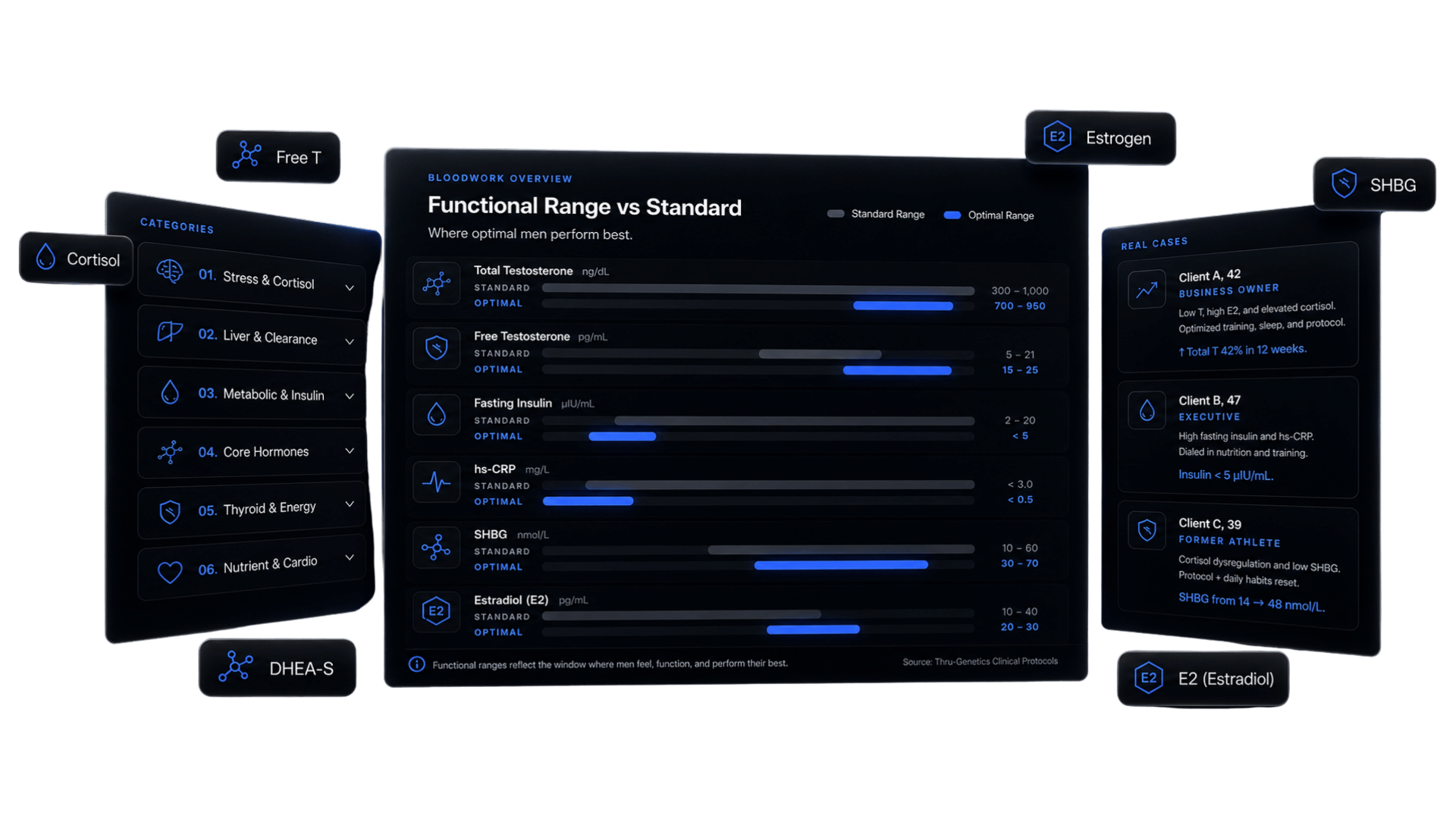
Your total testosterone came back at 940 and your doctor told you that you are fine. You are not fine. You are flat, your libido is gone, you are holding water around your midsection, and your training feels like wading through wet sand. So either you are imagining all of it, or the number you were handed does not describe what is actually happening in your body.
It is the second one. Total testosterone is an inventory count, not a measure of what your tissue is receiving. Three markers explain almost every case of this I see, and most panels never run any of them.
Why Total Testosterone Describes Almost Nothing
Testosterone does not float around your bloodstream waiting to be used. The overwhelming majority of it is bound to carrier proteins and biologically inert while it is bound.
Roughly 40 percent is locked to sex hormone binding globulin, which grips it tightly. Another 58 percent or so rides on albumin, which holds it loosely enough that it can still come off and be used. That leaves somewhere in the range of 0.5 to 3 percent circulating genuinely free, and that free fraction is what crosses into tissue and does the work.
So when your panel reports 940 ng/dL, it is reporting the whole warehouse. It tells you nothing about how much of that inventory is actually on the floor. Two men can walk in with an identical total testosterone of 940 and have free testosterone numbers that are nowhere near each other, because the binding proteins between them are completely different.
This is not a fringe position. The Endocrine Society clinical practice guideline explicitly directs clinicians to measure free testosterone in men whose conditions alter SHBG, precisely because total testosterone stops describing androgen status once binding shifts.
Marker One: Free Testosterone
This is the number that should have been run alongside your total, and the way it gets measured matters more than most clinics admit.
There are three ways a lab will give you a free testosterone value. The gold standard is equilibrium dialysis, which physically separates the unbound fraction and measures it directly. The accepted practical alternative is a calculated free testosterone, derived from total testosterone, SHBG and albumin using a validated equation such as Vermeulen. The third method is a direct analog based immunoassay, and the Endocrine Society tells clinicians outright not to use it, because it is inaccurate.
That third one is what a lot of cheap panels run. If your free testosterone came off an analog immunoassay, you did not get an answer, you got a number.
Even the calculated version has a real limitation worth knowing. There is a published case of a man with genetic SHBG deficiency whose calculated free testosterone came back squarely normal while direct equilibrium dialysis showed him frankly low. Calculation depends on the SHBG input being sane. When SHBG is at an extreme, the math breaks and the calculated number lies to you in a comforting direction.
Marker Two: SHBG
SHBG is the variable that explains why your total looks great and you feel like you were hit by a bus. It is a liver protein, and its production moves with your metabolic state.
SHBG rises with age. In healthy men, SHBG is measurably higher after 50 than it is in the twenties and thirties, while total testosterone across those same groups barely moves. Free testosterone falls anyway. That is the entire mechanism behind a fifty year old with a picture perfect total and the energy of a houseplant.
SHBG also climbs with hyperthyroidism, with liver disease, and with estrogen exposure. It drops with insulin resistance, excess visceral fat, hypothyroidism, high cortisol, and exogenous androgen use. Insulin is the big one. Insulin resistance is inversely correlated with SHBG in healthy men, and it is the most common driver I see in men over forty who run a business and have not been in a gym consistently for a decade.
Both directions cause problems, and they cause different ones.
High SHBG with a high total means most of your testosterone is bound and unavailable. You look optimized on paper and feel hypogonadal. This is the classic version of the man reading this article.
Low SHBG means a larger free fraction relative to your total, which sounds like a win and often is not. Low SHBG usually travels with insulin resistance and visceral fat, and more free testosterone in that setting means more substrate for aromatase, which brings us to the third marker.
Marker Three: Sensitive Estradiol
Most men on TRT have had their estradiol tested. Most of them have never had it tested correctly.
Standard estradiol immunoassays were built for women of reproductive age, where concentrations are high. In men, estradiol circulates at a fraction of that, commonly under 50 pg/mL, and the assay loses reliability at the bottom of its range. The professional guidance is direct about it: estradiol in men should be measured by a sensitive liquid chromatography tandem mass spectrometry method, because standard immunoassays cross react with other steroids and tend to overestimate at low concentrations. Below roughly 20 pg/mL an immunoassay is not measuring what it claims to measure.
Think about what that means in practice. A man gets a routine estradiol drawn on an immunoassay, it reads inflated, and someone decides he is aromatizing too heavily. An aromatase inhibitor gets added. Now his estradiol is being driven down from a starting point that was never real, and he ends up on the other side of the range where joints ache, libido dies, mood tanks and bone density quietly suffers. He has been treated for a lab artifact.
Estradiol in men is not the enemy. It is required for libido, bone, lipids and cognition. You cannot make a sane decision about it from an assay that cannot see it.
What to Actually Ask For
When you order or request the next panel, the request is specific. Total testosterone. Free testosterone by equilibrium dialysis, or calculated with SHBG and albumin reported alongside it so the math can be audited. SHBG. Estradiol by sensitive LC MS assay, not standard immunoassay. Draw it in the morning, fasted, and repeat it before anyone changes anything, because a single reading is a snapshot of a system that moves.
Then add the metabolic context, because SHBG is downstream of it: fasting insulin, HbA1c, a full lipid panel and hsCRP. If SHBG is being crushed by insulin resistance, the hormone conversation is the wrong conversation until the metabolic one gets handled. This is the same logic behind how we build every protocol.
Where This Goes Wrong
The failure is almost never malice. It is that the standard panel was designed to catch overt disease, not to optimize a functioning man, and total testosterone with a wide reference range clears that low bar easily. Reference ranges describe where 95 percent of a sampled population falls. They are not a statement about whether you feel like yourself.
If your symptoms and your labs disagree, the labs are incomplete, not wrong. Get the other three and the picture usually resolves in one draw.
FAQ
Can I have normal total testosterone and still be hypogonadal?+
Yes. If SHBG is elevated, most of your total is bound and biologically unavailable, and free testosterone can sit low while total looks unremarkable. This is why the Endocrine Society directs clinicians to measure free testosterone in men with SHBG altering conditions.
What is a good SHBG level for a man?+
Reference ranges vary by lab and rise with age, so there is no single number. What matters more is the direction and the driver. High SHBG with symptoms points at binding. Low SHBG usually points at insulin resistance and visceral fat.
Is calculated free testosterone accurate enough?+
Usually, and the Endocrine Society accepts a validated calculation as an alternative to equilibrium dialysis. The exception is when SHBG is at an extreme, where the equation can return a normal result on a man who is genuinely low by direct measurement.
Why does my estradiol need a sensitive assay?+
Because standard immunoassays are unreliable at male concentrations and tend to read high. Decisions about aromatase management get made off those numbers constantly, and the result is men driven into estradiol deficiency for no reason.
Should I retest before changing anything?+
Yes. Draw in the morning, fasted, and confirm on a second sample. Hormones move with sleep, illness, training load and time of day, and no protocol should be built on a single reading.
The personal experience shared in this article reflects an individual result under medical supervision. Results are not typical and will vary based on individual health status, protocol, and compliance. Nothing here should be interpreted as a guarantee of outcomes or a recommendation to self-administer any compound. Always consult a licensed physician before starting any peptide or hormone protocol.
THE BULLETIN
New reporting, straight to your inbox
One email when a new breakdown drops. Performance, hormones, peptides and longevity. No spam, unsubscribe any time.
Work With My Team
If your total testosterone looks fine and you still feel flat, the answer is usually sitting in the markers nobody ran. My team builds the panel around what is actually driving your symptoms, reads it in context with your training, your body composition and your metabolic data, and adjusts from there.